The Whole Field • Volume 5 • No. 2 • Full Moon • February 1, 2026

Table setting in blue
Stack of plates (detail)
Thumb cups
Schyler in the studio, circa 2023
Schyler the Potter • Stoneware and glaze • 2025

Guest Contribution: Becoming People of the Deer.
by Egypt Krohn
A note from Taylor: It isn't deer hunting season here in Michigan anymore, so this might seem like odd timing to share a write-up that centers venison and those four-legged creatures that graced previous hunting-centric writings, like Why Consider Hunting? and The Tip of the Mitt New Hunters Guild. I think the timing is perfectly apt, though. Egypt Krohn's writing, Becoming People of the Deer, presents more than facts, statistics, recipes, and stories—it offers a way of viewing place, decision-making, and sustenance attuned to one's watershed. What does this land support? What has it called for historically? And how might we best fit into those resilient patterns that humble us, yet through which there's mutual flourishing?
That's a deeply needed perspective, and I'm thankful that Egypt, of Grand Ledge's Dragonfly Downs Farm, was open to us featuring her write-up here. Enjoy.
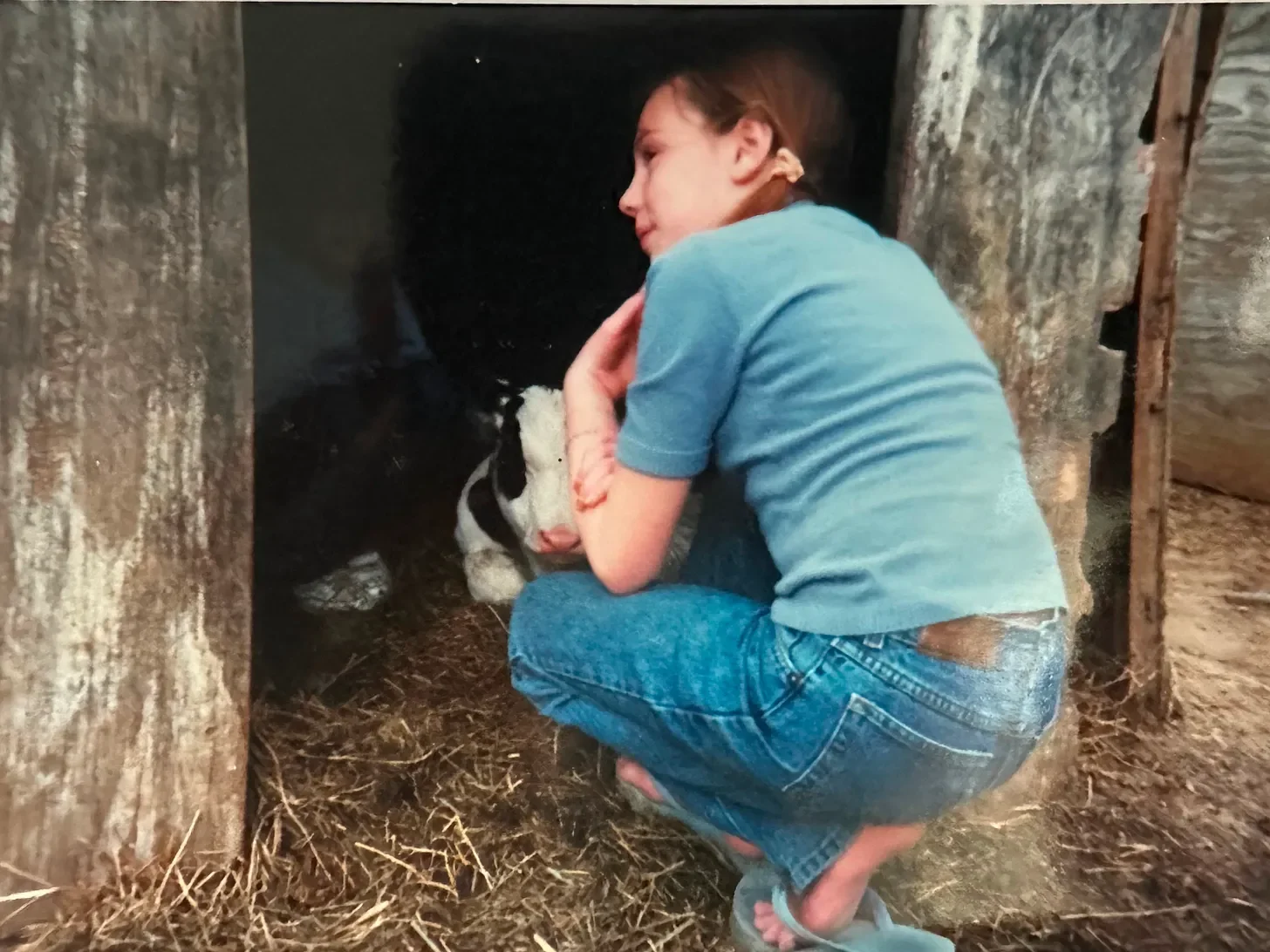
A photo of the author, offering a quick glimpse of their dairy-farming roots.
...Growing up as a cow family, the ways in which we cared for the cows that supported us were obvious. The reciprocal side of our relationship with deer is more subtle, less obvious, and it would be easy to forgo our side of the bargain, as our ancestors did in the 1800’s and nearly lost the deer as a result. The work is there, however. It starts with gratitude and responsible use. Waste nothing. Use every bit we can, and ensure someone else uses what we can’t. No piece of a deer carcass will ever reach a landfill from our hands. It is all returned to the earth to grow again.
Beyond respect and gratitude comes care for the resources the deer so vitally need. It comes from a reduction in our fossil fuel use, as much as we can manage and more every year. It comes from turning away from the agricultural practices that destroy their habitat. It comes also from restoring the native plants they need to be strong. Prairie plantings, native tree plantings, and, perhaps most critically, replacing as many of our non-native crops with native ones as we can manage. We show our love for the deer that we rely on in as many ways as we can imagine. We vow to never take their gifts for granted...

The Warp — Ideas and Inspiration
|| 1 || Do what you can, where you are. For many, it's seed-perusing, swapping, and purchasing time. Maybe you're out of the club, stuck in some sort of HOA situation where lawns are for ornamentals rather than any sort of endeavor involving consumption. If so, this might be intriguing. The small-scale seed-saving operation Great Lakes Staple Seeds offers a small collection of offerings that might support a clandestine bumper crop in its cleverly-named Hidden Harvest Collection. Orders from the company open up tomorrow, February 2nd.
Until then, there's plenty on their website, including their archive of classic ag bulletins, like Cornell's 1914 report, "Dandelions as Food". According to GLSS, "these now 'historic' documents are a valuable means to understanding agricultural practices in use prior to the days of commercial BigAg." I'll be honest: perusing the GLSS website and work was a bit of a rabbit hole, but the good kind. Thoughtful, down-to-earth, with a touch of sass. One last example: here's the PDF from their 2024 presentation, "Predictive yields for small-scale staple crop production in North Central States using common homestead equipment and minimal inputs," from the MIFFS (Michigan Food & Farming Systems) conference.
|| 2 || Again, that’s one of the keys: drawing folks to sense possibility and potency in their own skills, offerings, and organizing where they’re currently at. You know who was committed to that? Ella Baker. I wasn’t familiar with the civil rights icon until I read Ric Hudgen's "Growing Strong People: What Ella Baker Saw." As the eleven-minute trailer for Fundi: The Story of Ella Baker mentions, in the decades of the 1930s, 40's, 50's, and 60's, she worked with all of the well-known leaders, but mainly, she worked with unknown people.
"Miss Baker’s vision asks uncomfortable questions of those of us who claim to want change. Are we building power or performing resistance? Are we creating leaders or centering ourselves? Are we willing to work slowly enough that the people most affected can lead?
These aren’t historical questions. They’re questions for everyone who’s been to a march and wondered why nothing changed.
Ella Baker was about the hard, unglamorous work of building relationships, mobilizing communities, developing campaigns, and creating new organizers. She knew something King was still learning when he died at 39: beloved community doesn’t arrive. It’s built. Person by person, meeting by meeting, conflict by conflict. I still believe Miss Baker’s vision is the key to our democratic survival."

The Weft — News and Events
We’re heartened by a wide-range of expressions of resilient communities and gatherings. Here’s a smattering of regional events and happenings that reflect that diversity, collected for your consideration. Choose your own adventure!
|| 1 || We're hiring! Crosshatch is hiring a General Manager for XH Meeting Place + Mercantile in Bellaire. Curious to hear more? Click here to learn about the position and to apply.
|| 2 || 2026 Food and Farming Microloans. Crosshatch is now accepting applications for microloans, offered in partnership with Oryana Community Co-op. These loans are available to farms and food businesses in the following counties: Antrim, Benzie, Leelanau, Grand Traverse, Kalkaska, Manistee, Missaukee, and Wexford counties. Applications are due February 17, 2026. Find more information and apply
|| 3 || The Ship Yard: Blinker Fluid & Jacob Ramseyer. Tuesday, Feb. 3rd, 5:30-7:30pm at The Alluvion. Ship Yard is a community artist program supporting emerging local musicians. Be among the first to experience our region’s rising talent and support their journey as they set sail as artists! Find more on the evening and featured artists here.
|| 4 || Indigenous Food Sovereignty Summit. April 6-8th, at the Kellogg Hotel & Conference Center in East Lansing. Find details on the gathering, co-hosted by Michigan State University & University of Michigan, celebrating "Indigenous food systems, cultural resilience, and community-driven solutions for food sovereignty" here.
|| 5 || Food Literacy for All—January-April 2026. "Launched in 2017, Food Literacy for Allis a community-academic partnership course based at the University of Michigan. Structured as an evening lecture series, Food Literacy for All features different guest speakers each week to address challenges and opportunities of diverse food systems. The course is free and open to the public." Find the series schedule, more details, and instructions for registration here.
|| 6 || Antrim Writers Series presents: Teresa Scollon.
- Reading and Book Signing. Wednesday, Feb. 18th, 7-8:30pm, at Bee Well Mead & Cider, Bellaire, MI.
- Poetry Writing Workshop. Thursday, Feb. 19th, 1-3pm, at Grass River Natural Area, Bellaire, MI.
Find more details and register at the links above. The first 25 registrants will receive a free copy of Teresa's poetry collection, No Trouble Staying Awake.
|| 7 || Catalyzing Agroforestry Grant Program. "Direct financial support is available for farmers who seek to join our effort to mitigate climate change through agroforestry." Click hereto find out more about the payment per acre-based reimbursement program focused on implementing projects like "Alley cropping, Forest farming, Riparian forest buffers, Silvopasture, Urban food forest, and Windbreaks." Applications are now being accepted and are due March 3rd.
|| 8 || Commongrounds Cooperative (Traverse City) is hiring an Executive Director. Find more on the job description here and/or click here to apply.
|| 9 || Beekeeping. Various times, dates, and locations. Click the links for further details.
Benzie Bee Guild—Bee Classes begin on Saturday, February 7th.
Grand Traverse Beekeeping Club—Monthly meeting on Thursday, February 5th, 6:30-8:30pm. Open discussion on "What can we bee doing to prepare for the upcoming season."
Little Traverse Bay Beekeepers Guild—Monthly meeting. Tuesday, February 3rd, 6-8pm.
|| 10 || The MSU Product Center, in partnership with USDA Rural Development, will hold a free webinar on the USDA Value Added Producer Grant. The 2026 grant cycle is now open and accepting applications until the deadline, which is at 1:00 p.m., ET, on April 15, 2026. The free webinar will be held on February 5th, from 6:00-8:00 p.m. Register here.
|| 11 || Happenings at The Alluvion Between Now and the Next Whole Field include: the Vocal Opening Workshop Series with Laurel Premo, Funky Uncle, EXPAND Storytelling #10, The Jeff Haas Sextet featuring Laurie Sears, Rob Smith and Chris Glassman + Lisa Flahive, a special film screening of: The Best of the Best: Jazz from Detroit, Big Fun, The Bill Sears Quintet, and Funky Uncle & Big Greasy Funk Band's “Pre Fat Tuesday” Mardi Gras Takeover.
Find more information at thealluvion.org.

sponsored by:

Desmond Liggett Wealth Advisors is a mission-driven, fee-only wealth management company with a simple purpose: to generate exceptional value for the individuals, families, small business owners, and non-profit organizations they serve. Desmond Liggett Wealth Advisors believe in and adhere to triple-bottom-line analysis for portfolio investments, ensuring that they review how a company’s environmental and social values impact its long-term resilience and, consequently, value.
Crosshatch’s The Whole Field is a biweekly (meaning roughly every other week) human-written newsletter. We aim to provide engaging, thought-provoking content that’s worth your time. Click here to subscribe to our mailing list.
We also envision this best as a collaborative work. If you have any suggestions, leads, questions or feedback, let us know.
Copyright (C) 2025 Crosshatch. All rights reserved.